Beyond the Pay Gap: Why the Pension Gap Is Bigger and What We Can Do

Pension Gap
By Majella Mohan Coady, Financial Planning Consultant, Arachas Employee Benefits (With Insights from the Arachas Employee Benefits and Financial Planning Teams)

Many discussions about workplace equality focus on the gender pay gap, yet the issue that has the greatest impact on women’s financial futures in Ireland is the gender pension gap.

Previous Irish Life research shows a 36% difference in pension outcomes between men and women at retirement age, effectively requiring women to work eight additional years to reach the same pension pot. Pension auto enrolment through the Government’s new My Future Fund will improve access to saving, but it will not close the gap on its own. Much of the inequality is driven by earnings patterns, part‑time work, caring responsibilities and contribution gaps that disproportionately affect women over the course of their careers.

The challenge is reflected across Europe, where women receive pensions 22% lower than men on average.  Understanding the drivers behind this gap and the practical steps that can strengthen women’s retirement outcomes, is essential.

Drawing on insights from our financial planning & employee benefits teams this article outlines the key factors influencing the pension gap and the actions that can make a meaningful difference.

Lower lifetime earnings and shorter careers – Irish Life analysis shows women earn 22% percent less on average and spend around six fewer years in paid employment, which reduces both employee and employer pension contributions over time.

More women in part-time work – CSO figures show women accounted for 67.3% of all part-time workers in Q4 2024 while representing only 41.9% of full-time workers. Part‑time roles typically involve lower employer contributions and reduced long‑term earning potential.

More women providing unpaid care – Census 2022 recorded 299,128 unpaid carers in Ireland, with women making up 61%. Almost a third provide over 43 hours of unpaid care per week. This caring period often restricts paid employment and creates pension contribution gaps during pivotal mid‑career years.

Investment strategy differences – OECD research shows that women often hold lower-risk investment allocations in asset‑backed pension plans. Over time this can leads to slower pension growth compared with men.  

Similar saving habits, different outcomes – Irish Life found that women and men start saving at the same average age and contribute similar percentages of salary. This indicates the gap is driven by inconsistent working patterns and income differences, rather than willingness or interest in pensions.

Additional top‑ups and AVC behaviour – Research also shows that men are 60% more likely to make single‑premium Additional Voluntary Contributions (AVCs). This behavioural difference contributes to wider long‑term pension outcomes.

Lower use of digital pension tools – Irish Life also found that men are more proactive in using digital tools such as the Irish Life Pension Portal and Tax Calculator. Members who have registered for the Pension Portal are projected to retire with funds 54 percent higher on average than those who have not registered, reflecting the value of regular monitoring and engagement.

Financial Planning: Insights from Sean Buggy, Associate Director Financial Planning

Sean Buggy works with individuals at different stages of their financial planning journey and regularly sees how career patterns and income differences influence women’s ability to build pension savings at the same pace as men, particularly where part‑time work or caring responsibilities arise.

“In financial planning conversations, you see the same pattern across the industry. The reality is that women face structural barriers such as time out of the workforce and lower average salaries, so their projected retirement savings tend to lag behind men of similar age and career stage. But with guidance and more consistent engagement, those gaps can be narrowed significantly.”

Sean notes that early awareness of the long‑term impact of career decisions can help individuals make more informed adjustments throughout their working lives. He adds:

“Early action makes a meaningful difference. Small, steady decisions taken throughout a career can have a transformative impact on long term retirement outcomes, particularly where someone may have periods away from the workforce.”

The Employer Opportunity: Insights from Barry Sinnott, Associate Directors at Arachas Employee Benefits

Employers can play a significant role in helping reduce the gender pension gap. European evidence shows that career interruptions and reduced working hours are the biggest contributors to women retiring with smaller pensions and these are areas where employers can provide meaningful support.

Barry Sinnott, who leads the Arachas Employee Benefits team and advises employers on pension and benefit strategy, has seen these patterns across many organisations. Drawing also on insights from his previous experience in Irish Life, Barry explains:

“In most cases the pension gap is not caused by a lack of interest or engagement. It is usually driven by structural factors such as income levels, time out of the workforce and the loss of employer and employee contributions during periods of maternity or other caring leave.”

Barry suggests clear policies and practical supports are key.

“Employers are in a strong position to influence retirement outcomes. Policies that support continuity of employment and offer inclusive benefits, including consideration of contributions during leave, make a real difference to closing the gap.”

Practical steps employers can take include:

  • Ensuring part-time and variable‑hour staff have full access to pension schemes
  • Embedding pension discussions in maternity, parental or caring leave processes
  • Reviewing how employer pension contributions are treated during leave periods
  • Encouraging early engagement with AVCs
  • Providing clear, accessible pension communication and digital guidance
  • Reviewing flexible working, progression pathways and returner support

Supporting Women Through Awareness: Insights from Anna Marie O’Sullivan, Employee Benefits Senior Consultant

Anna Marie regularly sees how easily pension planning can be pushed aside when work, family and caring demands build up.

“In our work with members, we often see pension planning slip down the priority list, especially for women balancing work, family and caring responsibilities. Even small increases before and after time out of the workforce can make a meaningful difference to financial independence later in life.”

She notes that many people underestimate the long‑term impact of reduced hours or career breaks on their future pension income.

She continues:

“Many women plan ahead for everyone except themselves. Retirement planning does not need to be complicated. It starts with knowing where you stand and taking small, manageable steps that fit your circumstances.”

Practical Steps Women Can Take Today

While the structural factors behind the pension gap are significant, there are practical steps women can take to strengthen their long‑term financial position.

1. Make the most of AVCs – Additional Voluntary Contributions, even at low levels, can have a meaningful cumulative effect when started early.

2. Use digital tools to stay informed – Platforms such as the Irish Life Pension Portal help you track progress, model AVCs and understand projected retirement income.

3. Plan proactively for career breaks – If you expect to take maternity, parental or caring leave, review what it means for your pension and consider:

  • Keeping a small contribution going if affordable
  • Increasing contributions before or after the break
  • Understanding employer supports that may apply

4. Review your pension regularly – Check your fund value, contributions and projected retirement income at least once a year. Small changes made early have a much greater long-term impact.

5. Increase contributions when circumstances allow – If you return from leave or move from part‑time to full‑time work, consider a small increase to help compensate for earlier gaps.

6. Understand your State Pension eligibility – Review your PRSI record and ensure any eligible caring periods are captured. Knowing how the State Pension aligns with your workplace pension helps build a clearer retirement plan.

7. Seek advice early – Don’t wait until they are close to retirement to seek guidance. Engaging with advice earlier in your career can help you understand your options, choose an appropriate investment strategy and make more informed decisions.

Looking Ahead

Auto‑enrolment has widened access to retirement saving, but closing the gender pension gap requires more than participation. It requires awareness, supportive workplace practices and sustained engagement at key career stages.

Julie Galbraith, Chief Business Officer at Arachas, emphasises:

“As employers, we have a responsibility to understand how career patterns and caregiving responsibilities influence long‑term financial outcomes. Supporting employees with clarity, structure and inclusive policies is an important part of building a workplace where everyone can plan confidently for their future.”

International Women’s Day is a reminder of the progress made and the work still ahead. Ensuring women can retire with financial independence must remain a priority for employers, advisers and policymakers. With early planning, clear information and supportive workplace environments, we can help deliver stronger retirement outcomes for women across Ireland.

Frank Glennon (Life & Pensions) Limited, trading as “Arachas Employee Benefits”, “Arachas Financial Planning”, “Glennon”, “Glennon Employee Benefits” and “Glennon Financial Planning”, is regulated by the Central Bank of Ireland.

Sources:

Protecting Family Businesses: Why Shareholder Succession Planning Matters

boardroom

Family businesses are built on trust, legacy and long-term relationships. But what happens when the unexpected occurs – such as the death of a shareholder? Without a clear succession plan, both the business and the family may face serious financial and operational challenges.

That’s why it is essential for shareholders to think ahead. Planning for succession is not just about protecting the company and ensuring business continuity, it is also about safeguarding family harmony. The consequences can be significant for both surviving shareholders and the next of kin. Here are some of the most common issues each may face – and why having a financial safety net, such as shareholder protection insurance, can make all the difference:

Surviving Shareholders – Potential Issues

  • Loss of Control – If the deceased owned more than 50% of the company, the remaining shareholders may find themselves working with a new controlling shareholder – possibly the deceased’s spouse or children. This can lead to disagreements about how the business should be run, especially if the new shareholder has no prior experience in the business.
  • Refusal to Sell – The ideal outcome for surviving shareholders may be to buy back the deceased’s shareholding from their next of kin. But what happens if the next of kin refuses to sell? This could result in deadlock and strain on business operations.
  • Lack of Liquid Capital – Even if the next of kin is willing to sell, the surviving shareholders may lack sufficient liquid capital to purchase the shares. Borrowing the necessary funds could result in a long-term financial burden, and this financial strain can affect growth and stability.
  • Shares Passed to an Outside Party – If the next of kin wants to sell and the surviving shareholders are unable to buy, the shares may be sold to a third party – possibly a competitor or someone with no experience in the business. This could disrupt the company’s long-term strategy and introduce competitive risk.

Next of Kin – Potential Issues

  • An Illiquid Asset – If the shares are not sold, the next of kin may be left holding a paper asset that produces little or no income. This situation could be even more serious if the shares trigger an immediate inheritance tax liability, creating financial stress during an already difficult time.
  • No Ready Market for Shares – There may be no obvious buyer for the shares, leaving the next of kin in a difficult financial position. This lack of liquidity can delay estate settlement and family financial planning.

A Real-Life Scenario

Imagine a family-owned artisan bakery in Ireland. Two brothers run the business together. One owns 60% of the shares, and the other owns 40%. Everything works well – until the unexpected happens. The majority shareholder passes away suddenly.

What happens next? His shares go to his next of kin, who has no experience running a bakery. Overnight, the surviving brother loses control of the business. He wants to buy back the shares to keep the bakery in the family, but there’s a problem: he doesn’t have the cash. Taking out a large loan would put the business under financial strain. If he can’t buy the shares, the next of kin might sell them to an outsider – maybe even a competitor. This could change the direction of the business completely.

Now imagine the same situation with shareholder protection in place. The bakery has a corporate shareholder protection policy. The company owns life insurance policies on its shareholders. When one shareholder dies, the policy pays out a lump sum to the company. That money is used to buy back the shares from the deceased’s estate. The result? The surviving brother keeps control of the bakery, the family receives fair value for their shares, and the business continues without disruption.

For smaller businesses or those with only two shareholders, personal shareholder protection may be more suitable. In that case, each shareholder takes out a policy on themselves, and the payout is used by the other shareholder to purchase the shares.

Why Planning Matters and the Role of Expert Advice

Without proper planning, the death of a shareholder can create uncertainty for both the business and the family. It can lead to loss of control, financial strain, and even the sale of shares to outsiders. For the next of kin, it can mean holding an illiquid asset that is difficult to sell and may trigger tax liabilities.

The right shareholder protection ensures funds are available to buy back shares quickly and fairly. This helps the business remain in the hands of the surviving shareholders while giving the family financial security during a difficult time.

Getting expert advice is essential. A qualified financial advisor with experience in business protection can support the process, working hand in hand with your own professional legal and tax advisors and will liaise with the insurers’ underwriters throughout. A well-structured plan aims to:

  • Identify the most suitable shareholder protection strategy, whether corporate or personal.
  • Assess liquidity needs for surviving shareholders and next of kin.
  • Structure buy-back arrangements to minimise tax exposure, which can vary significantly depending on how policies are structured and how payouts are treated.
  • Ensure the plan is legally sound, fair, and aligned with both business and family interests.

Working with specialists ensures that all financial, operational and tax considerations are accounted for, helping to avoid costly mistakes and unintended outcomes. By putting a clear, practical, and tax-efficient plan in place, businesses can secure continuity, maintain control, and protect family relationships.

If you want to make sure your business is prepared and your succession plan is robust, contact us today to discuss your options and put a plan in place that works for your business and your family.

E: [email protected]    Ph: 083 8618048

Frank Glennon (Life & Pensions) Limited, trading as “Arachas Employee Benefits”, “Arachas Financial Planning”, “Glennon”, “Glennon Employee Benefits” and “Glennon Financial Planning”, is regulated by the Central Bank of Ireland.

Why Health & Wellbeing Belong at the Heart of Your Employee Benefits Strategy

happy-employees

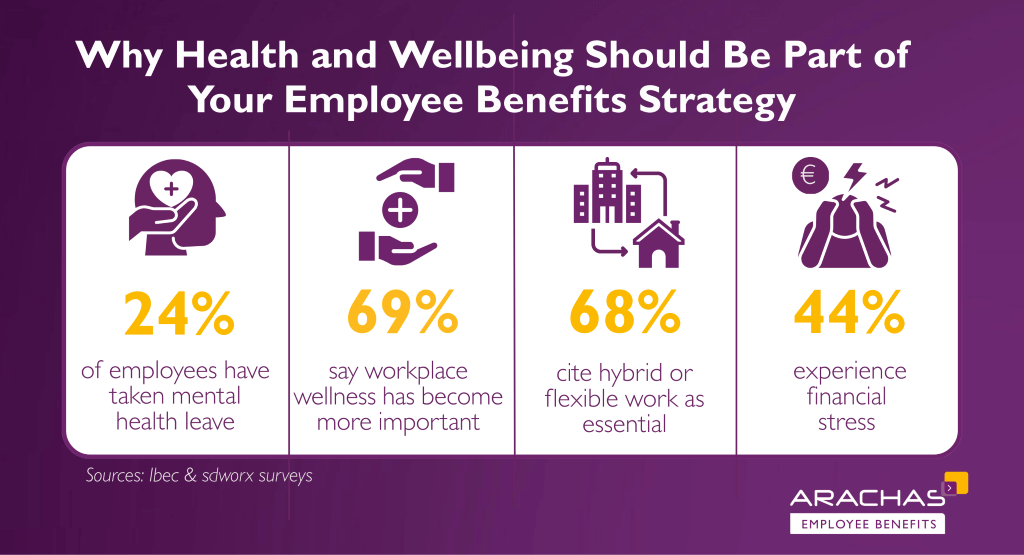
Employee wellbeing has moved from a “nice to have” to a business-critical priority in Ireland. Organisations are recognising that wellbeing impacts engagement, retention and productivity. According to Ibec’s Workplace Wellness research, 69% of employees say workplace wellness has become more important in recent years and 68% cite hybrid or flexible work as essential to their wellbeing. Many will even trade pay for flexibility, with 35% saying they would leave a well-paid role for better hybrid options. This signals that flexibility is no longer just a perk, it is a core expectation.

The Business Case: Why Wellbeing Matters

Wellbeing is not just about doing the right thing for employees. It is about performance and risk management. CIPD’s HR Practices in Ireland 2025 report shows that 51% of organisations now have wellbeing on the senior leadership agenda, and 36% report it has become more challenging to manage. Mental health was identified as being one of the leading causes of absence in 25% of organisations. Acute medical conditions were only fractionally higher at 26%. SD Worx research highlights that almost one in four Irish employees has taken mental health leave, compared to an EU average of 18%. These figures underline the cost of inaction and the need for proactive strategies.

wellbeing-graph

What Employers Are Offering

Irish employers are responding with a mix of benefits. CIPD Ireland data and industry research show:

  • Group Pensions: Around half of employers offer an occupational pension scheme. These schemes are almost universal among larger organisations. With the introduction of pension auto-enrolment this month, more SMEs are considering setting up company pension schemes as a more flexible and in many areas, attractive option, to attract and retain employees.
  • Group Life assurance and income protection: Frequently included in packages for medium and large employers.
  • Private medical insurance: Offered by many larger organisations and overall 46% of the Irish population has private health insurance. Many employees also take advantage of company-negotiated discounts and schemes offered by health insurers.
  • Wellbeing initiatives: CIPD reports that 56% of organisations provide online wellbeing initiatives and 54% are increasing investment in mental health support.

These numbers show that while financial benefits remain the foundation, health and wellbeing supports are becoming standard practice.

Mental Health: From Awareness to Action

Employers increasingly recognise their responsibility. UCC’s Healthy Workplace Ireland report found that 76% of employers agree they are responsible for employee mental health (81% agree in larger firms), but only 20% have a dedicated budget to support employees mental health and just 32% have a wellbeing lead at board level. This gap between intention and investment is significant. Without resources, even the best intentions cannot deliver impact. Practical steps such as employee assistance programmes, counselling services and mental health champions can make a real difference.

Culture matters too. CIPD research shows that half of organisations encourage employees to disconnect after hours, which helps tackle burnout and supports healthier work-life balance. SD Worx also reports that 50% of employees describe their work as mentally demanding or stressful, and 29% say their job negatively affects their mental health. These findings show that mental health challenges are not just personal—they are organisational issues.

tired

Financial Wellbeing: The Overlooked Factor

Financial stress often goes unnoticed, yet it significantly affects performance and mental health. Research from SD Worx shows that 44% of employees in Ireland experience financial stress, and Ibec reports that 41% of HR leaders identify financial wellbeing as a top challenge for the year ahead.

Employers can make a real difference by offering financial education, budgeting tools and pension guidance. These supports help employees feel more secure and reduce stress that can spill over into work.

The Regulatory Imperative: CSRD in Ireland

Wellbeing is no longer just a competitive advantage – it’s becoming a compliance requirement. Ireland has transposed the EU Corporate Sustainability Reporting Directive (CSRD) into law, introducing phased obligations for companies to report on workforce wellbeing metrics as part of ESG disclosures.

Large companies, public-interest entities and non-EU organisations with a significant EU presence will need to provide detailed data on areas such as health, safety and mental wellbeing. While CSRD may not explicitly mandate a wellbeing strategy, the depth of reporting required will, in practice, push companies to implement structured wellbeing initiatives.

When reviewing your employee benefits, it’s worth considering these requirements and whether your company is in scope. Aligning your benefits with these expectations now will help you stay compliant and strengthen your sustainability approach.

Practical Steps for Irish Employers

1. Audit and Baseline: Review your current benefits, utilisation and absenteeism data.

2. Invest in Mental Health: Provide Employee Assistance Programmes (EAPs), counselling and manager training.

3. Embed Flexibility: Make hybrid work part of your wellbeing approach.

4. Support Financial Wellbeing: Offer budgeting tools and pension advice.

5. Enhance Health Benefits: Consider private medical insurance and wellbeing programmes to support physical and mental health.

The Bottom Line

Wellbeing is now a business priority in Ireland. Employees expect it, leaders are focusing on it and regulators may require it. An Employee Benefits Strategy that puts health, mental health, flexibility and financial resilience at its core along with pensions and protection benefits will help organisations attract and retain talent and build a more engaged and resilient workforce.

If you want to explore how to strengthen your benefits strategy with wellbeing initiatives, pensions and protection, talk to our Employee Benefits team today. Call +353(0)1 7075880 or email [email protected]

Frank Glennon (Life & Pensions) Limited, trading as “Arachas Employee Benefits”, “Arachas Financial Planning”, “Glennon”, “Glennon Employee Benefits” and “Glennon Financial Planning”, is regulated by the Central Bank of Ireland.

Auto-Enrolment System – All You Need To Know

AEB

Ireland’s Pensions Landscape to change irrevocably, with the introduction of a new statutory retirement savings system to be implemented January 2026.

On July 9th 2024, the President of the Republic of Ireland, signed a bill that had passed both houses of parliament, the Dáil and the Seanad (house and senate); the Automatic Enrolment Retirement Savings System Bill 2024 (Bill 22 of 2024). More than 20 years in the making, this new legislation will have implications for both employers and employees in the Republic of Ireland, even where an employer currently operates and offers membership of an occupational pension scheme or Personal Retirement Savings Account (PRSA).

This change and its impact should not be understated, and preparation is now necessary by employers for this implementation and decisions will need to be made regarding their pension / retirement planning offerings to their employees.

What does this mean once implemented (expected January 2026) and who will be impacted?

All employees aged between 23 and 60, earning €20,000 annually from all employments will fall into the scope of automatic enrolment (AE). Those outside of these ages may also opt in.

The contributions that will require to be made in month 1 of implementation will be 1.5% Employer and 1.5% Employee (of total earnings). With employee gross equivalent contribution taken from net pay. Employer contribution will have no tax implication for the employee, the employee contribution, unlike current DC savings available through the private sector, will not be tax relieved – instead it will be topped up with a 0.5% Government contribution. Over 10 years from implementation, the percentages will increase to an overall 14% combined, with 6% Employer, 6% Employee and 2% Government.

NB Any employee in exempt employment will not be automatically enrolled in the Government System, once implemented. Who is deemed exempt; an employee who is in the AE scope will not be pulled into the government scheme where they are currently making a pension contribution via payroll – of any kind – this can be employer only, employee only or a combination of the two. If they stop contributing to a current arrangement at any time they will be brought into AE, and must wait 6 months to opt out, or recommence / join a pension at which point they will be in exempt employment again.

The new National Automatic Enrolment Retirement Savings Authority (NAERSA) will not review standards in relation to current schemes until year 6 of operation. So at commencement any contribution will do for exemption.

The Government will be utilising a look back approach to enable notification of contributions for their system to employers in December 2025 for January 2026 payroll, so employers who do not wish to participate in the government system must ensure that their employees are enrolled in a plan and actively contributing via payroll by November 2025 payroll, to avoid having to lodge an appeal in January 2026.

What steps do employers need to take?

Consult with their broker to undertake the following;

  • Review current pension arrangements (if any), and philosophy to this benefit.
  • Review current scheme membership to determine the % of employees that would be impacted by AE (if any) and what the cost implications are if they wish to move to 100% participation in their own scheme.
  • Review potential cost of AE if no scheme in place.
  • Determine a course of action; to enable them to ensure they do not have to participate with AE if they choose not to; to decide if they will let two schemes operate AE and their own; if nothing in place – take action to put a scheme in place or simply allow AE to consume their employees into the Government system.

Next steps for employers to consider;

1. Talk to a broker – it would be important to take stock now, understand and review what your competitors are doing in this space in order to continue to attract and retain your own employees. Pension saving in Ireland will be spoken about more than ever before once the mass communication campaign commences, with employees comparing and contrasting.

2. Develop your AE strategy and be prepared to move forward once the implementation date is known.

3. Manage communications with your employees in Ireland as implementation nears, with your broker’s support.

Davin Spollen is Chief Executive Officer of Glennon Employee Benefits and Vice President of the Irish Institute of Pensions Management (IIPM). Davin is an Associate of the IIPM, Qualified Pension Trustee and Certified Financial Planner.

If you / your clients require any assistance in Ireland please reach out to Davin and his team [email protected]

Attention Occupational Pension Scheme Trustees

If you are an employer with your own pension scheme, there are significant decisions you will have to make this year as new legislation introduces the most significant changes to occupational pension schemes, their management and regulatory framework in at least a generation.